Two discovery slots open for the January–March 2027 window. Send a brief →
Apricot Signal
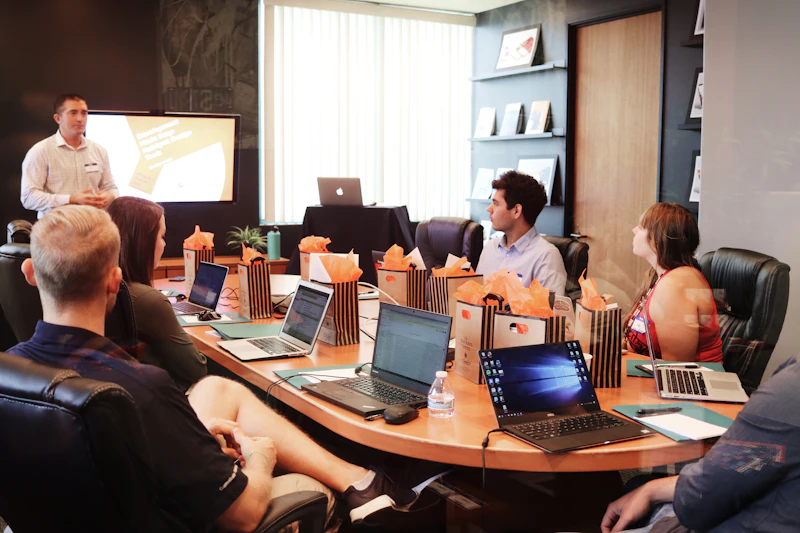
A quiet studio meeting room with a long table, glass partitions and afternoon light

Independent brand & product studio

Positioning, identity and the surfaces that carry it.

We join small teams for a focused stretch: work out what the company is actually selling, rebuild the brand around that answer, then design the pages, decks and packaging it has to live on. Four practitioners, one live project at a time.

Studio hours Monday to Thursday · Briefs read weekly

Now booking
January–March 2027 discovery
Studio size
Four practitioners, no account layer
Typical start
Two to three weeks from a signed brief

How we work

Five stages, in this order

The sequence rarely changes, because skipping the first stage is what makes the rest expensive. Durations below are for a full rebuild; a sprint compresses stages one and two and stops there.

  1. 01

    Read the room

    Interviews with the people who sell, support and build. We read your last two quarters of enquiries and the objections that keep coming back. No workshops with sticky notes.

    Weeks 1–2
  2. 02

    Pick the fight

    One written positioning note: who the company is for, what it replaces, and the three things it will stop claiming. You sign off on this before any design begins.

    Weeks 3–4
  3. 03

    Build the identity

    Wordmark, type system, colour roles, photography direction and the rules for how they behave together. Two directions explored properly, not six explored thinly.

    Weeks 5–8
  4. 04

    Ship the surfaces

    Whatever carries the message first: site, pitch deck, pack, trade sheet, hiring page. Designed and front-end built by us, or handed to your engineers with a component sheet.

    Weeks 9–13
  5. 05

    Hand over the kit

    Source files, a short written guide your team will actually open, and one working session with whoever maintains it. We stay reachable for a month after handover.

    Week 14

Engagements

Three ways to work with the studio

Most enquiries arrive asking for the middle option and need the first. Compare the runway and the cadence before the deliverables — that is usually where the decision sits.

Engagement comparison
Engagement Best for Runway Cadence What lands
Signal Sprint Teams who know something is off in how they describe themselves, but not what. 3 weeks Two working sessions a week, everything else async. Positioning note, message hierarchy, a one-page narrative your sales team can read aloud.
Full Rebuild A rename, a merge, or a bet on a category the current brand cannot reach. 10–14 weeks One review a week with your decision maker, build work between. Identity system, type and colour kit, photography direction, site design and build, launch sequence.
Embedded Quarter In-house teams with more scope than hands, who want output rather than advice. 12 weeks, renewable Two days a week inside your tools, your stand-ups, your backlog. Design work at your team's pace, a maintained component library, written handover at the end.

Selected work

Three recent engagements

A short index rather than a gallery. Each entry is the problem as the client first described it, and what changed by handover.

The studio

Four people, no account layer

Apricot Signal is a strategist, two designers and a front-end developer. The people in your first call are the people who do the work, and we hold one live project at a time so nobody is being split across three.

We take on companies past their first shape — the ones with real customers, a story that has drifted, and a team small enough to change direction in a quarter.

  • Positioning & messaging
  • Naming
  • Identity systems
  • Typography
  • Art direction
  • Web design
  • Front-end build
  • Design systems
Four colleagues gathered around a laptop reviewing design work in a bright studio
The studio, mid-review — one project on the wall at a time

Before you write

Questions we answer on most first calls

If your question is not here, put it in the brief form and we will answer it directly rather than send a deck.

How do you price a project?
Fixed fee per engagement, quoted after one call and a written brief — never hourly. The fee is set by scope and runway, invoiced in three parts across the project. Sprints are the smallest commitment we take.
Do you work alongside an in-house design team?
Often. That is what the embedded quarter is for: we work in your tools and your backlog, at your cadence, and your team keeps ownership of the day-to-day. We do not take over reporting lines or run your people.
How soon can you start?
Two to three weeks from a signed brief, within an open discovery window. We are currently booking January to March 2027. Because we hold one project at a time, windows close in order of signature, not enquiry.
Do you build the site or only design it?
We design and front-end build marketing sites ourselves. For product interfaces we design the screens and hand your engineers a component sheet with states, spacing and behaviour written out — we do not take on application development.
Who owns the work at the end?
You do, in full, on settlement of the final invoice: source files, editable artwork and production assets. Any licensed typeface is bought in your company's name so the licence sits with you, not with us.
What do you need from us before the first call?
Three things: the person who can approve a direction on the call, a sentence on what changed recently, and your hard constraints — a launch date, a retailer requirement, an existing name you cannot touch.
Will you take on a single deliverable, like a logo?
Only as part of positioning work. A mark drawn without a clear answer to who the company is for tends to be replaced within two years, and we would rather not be the studio that drew it.

Start a brief

Tell us what needs to change

A few sentences is enough to start. We read briefs once a week and reply with either a call time, a smaller suggestion, or an honest no.

We use what you send to reply to your enquiry, nothing else.